Canada’s economy in 2026 is best described in a single word that appears again and again in forecasts: modest. After the turbulence of recent years, growth is expected to be positive but subdued, inflation has proven a little stickier than hoped, and the shadow of tariffs and trade uncertainty hangs over an economy that depends heavily on exports. None of the major forecasters expects a boom, and few expect a recession; the central scenario is a slow, uneven expansion.
At a glance
- Forecasts for 2026 GDP growth cluster around 1% to 1.5%, with private-sector and international estimates in that band.
- The unemployment rate is expected to average roughly 6.5% in 2026 before easing over the following years.
- Inflation rose to 3.0% year-over-year in July 2026, at the top of the Bank of Canada’s target range, largely on gasoline prices.
- Tariffs and trade uncertainty are widely cited as the main drag on the outlook.
- Government spending on defence and infrastructure, plus household consumption, are expected to underpin growth.
Growth: positive but slow
The range of published forecasts for 2026 real GDP growth is relatively narrow. Private-sector economists surveyed for the federal government’s spring update pointed to growth around 1.1%, the OECD projected about 1.2%, and several bank economists landed between roughly 1.3% and 1.5%. The common thread is an economy expanding, but well below the pace that would quickly absorb slack or drive strong gains in living standards.
A recurring caveat in these forecasts is that Canadian output is not expected to return to the path it was on before the recent wave of trade tensions. Some projections suggest real GDP could remain meaningfully lower by the end of the decade than it would have been without the tariff shock, a reminder that trade disruptions can leave a lasting mark rather than a temporary dip.
Jobs and inflation
The labour market has softened from its tightest post-pandemic point but remains far from crisis. The unemployment rate is projected to average around 6.5% in 2026, an improvement on some earlier expectations, with a gradual decline anticipated over the following years as the economy finds its footing.
Inflation, meanwhile, ticked up to 3.0% year-over-year in July 2026, placing it at the top of the Bank of Canada’s 1% to 3% control range. Much of that increase reflected gasoline prices rather than a broad-based acceleration; the Bank’s core measures were closer to 2%. The distinction matters, because it shapes whether the central bank sees the pickup as temporary or as a signal that underlying price pressures are rebuilding.
The tariff overhang
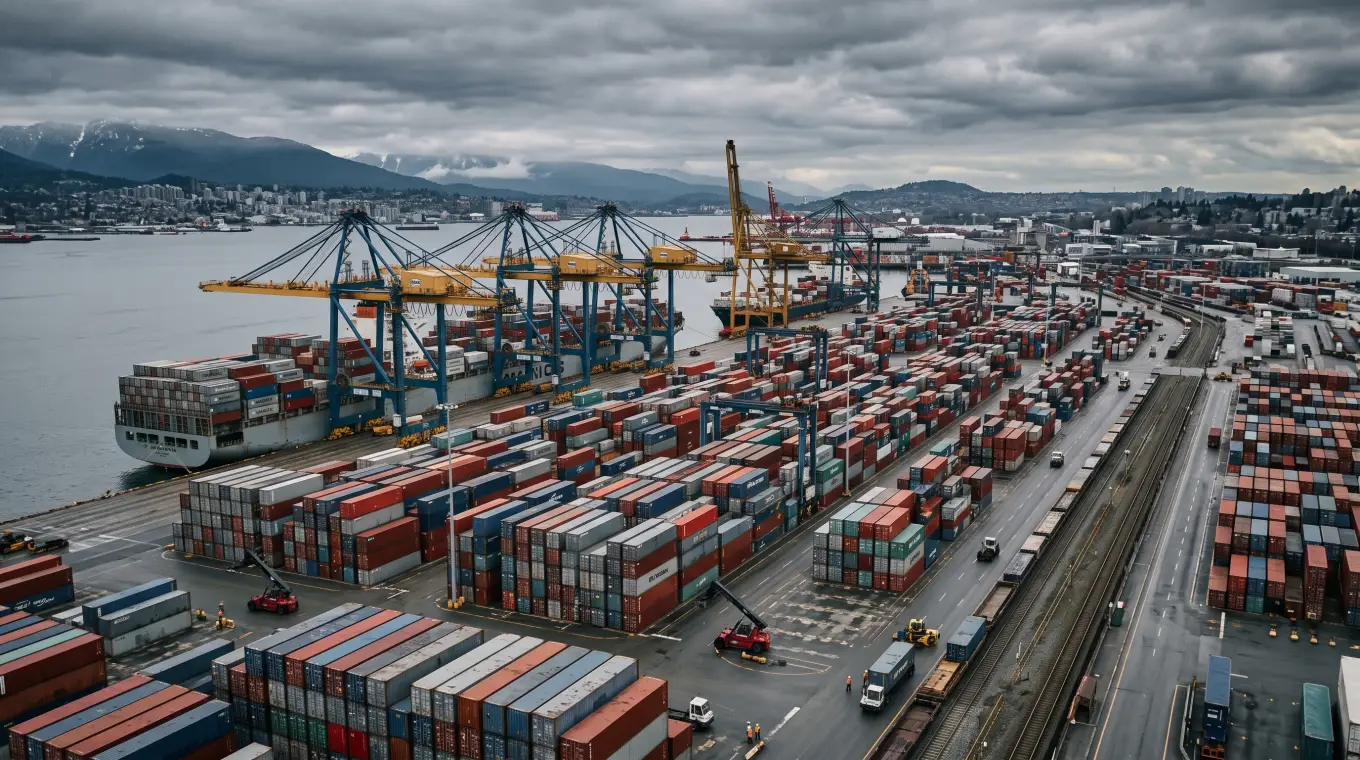
If there is a single theme that unifies the 2026 outlook, it is trade. Canada’s economy is unusually open, and the United States is by far its largest export market. Elevated tariffs and the uncertainty surrounding the future of the Canada–United States–Mexico Agreement (CUSMA) weigh on business investment and export-sensitive industries. Economists broadly expect trade uncertainty to persist rather than resolve quickly, which discourages the kind of long-term investment decisions that drive productivity.
Why trade uncertainty matters so much here
Because exports make up a large share of Canadian output, shifts in tariff policy and market access ripple through manufacturing, resources and the businesses that supply them. Uncertainty alone — not knowing the rules a year out — can be enough to delay hiring and investment.
What supports the economy
Against these headwinds, forecasters point to a few sources of support. Household consumption continues to underpin activity, even if higher mortgage payments at renewal are tempering it. Government spending, particularly on defence and infrastructure, is expected to add to growth. And business investment, while cautious, is generally projected to recover gradually rather than contract.
What it means for households
For families, a modest-growth, sticky-inflation economy translates into a familiar mix: prices still rising, though more slowly than at the peak; a job market that is steady but not booming; and borrowing costs that have plateaued rather than fallen. The practical implication is that the fundamentals of household budgeting — comparing prices, checking the real rate on savings, and planning for mortgage renewals — matter as much as ever. The macro numbers set the backdrop, but the decisions that move a household budget are still made one at a time.
Sources: Government of Canada, Spring Economic Update 2026, OECD Economic Outlook, Canada, 2026 and Statistics Canada, Consumer Price Index, July 2026. Forecasts reflect the information available at the time of publication and are regularly revised.
This article is for general information only and does not constitute financial or investment advice. Economic forecasts are inherently uncertain and can change as new data arrives. For decisions affected by the economic outlook, consider consulting a qualified professional and reviewing current official sources.